Report copyright infringement where the copy lives. Use the platform's copyright form if it has one. Otherwise, email a DMCA notice to the website's copyright agent, and if it does not act, to its hosting company. Report the Google result separately through Google's legal removal form. Every report needs the same core: your work, the exact URL of the copy, your contact details and two signed statements.
Where do you report it: host, Google or platform?
| Where the copy is | Where to report |
|---|---|
| A big platform (YouTube, Instagram, TikTok, Reddit, X) | The platform's own copyright form. It is faster than email and asks for exactly what it needs. |
| A website or forum | The site's DMCA, copyright or abuse address, usually linked in the footer. US sites list a designated agent in the US Copyright Office's DMCA agent directory. |
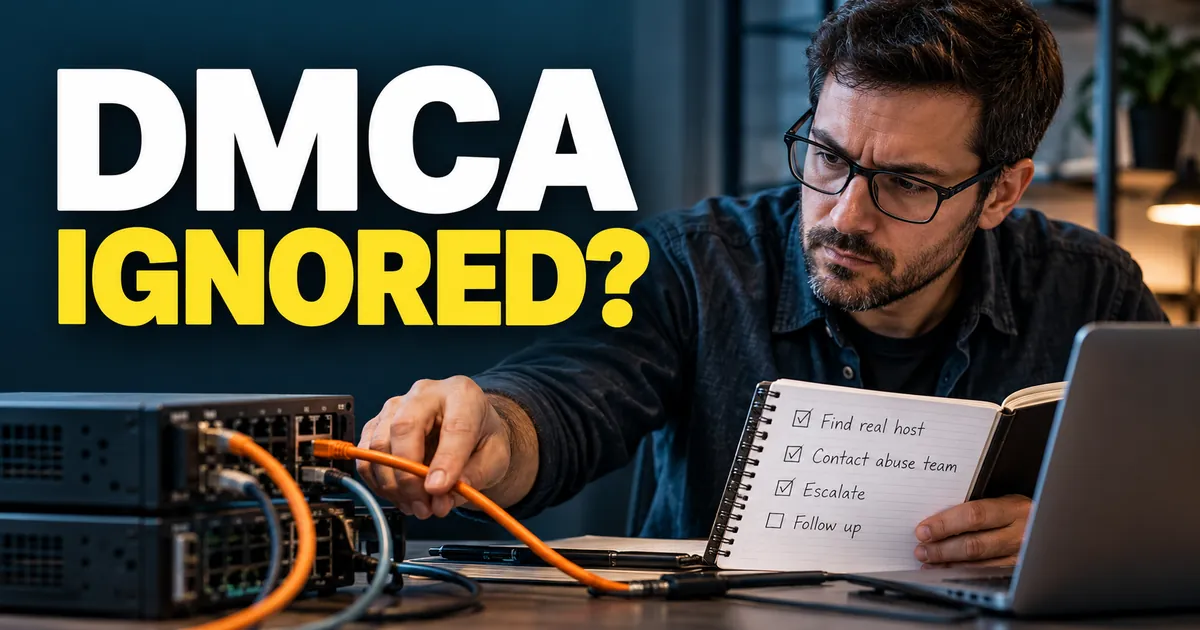
| A site that ignores you | Its hosting company's abuse team. Look up who hosts the domain and send the same notice. |
| A file host (MEGA, Gofile, Pixeldrain) | The host's own route. See our guides for MEGA, Gofile and Pixeldrain. |
| Google Search results | Google's legal removal form, choosing Web Search and copyright. Report the exact result URL, not the site's home page. |
Report to the site and to Google at the same time. Removing the copy deletes it; removing the Google result stops people finding it while you wait.
What do you send?
- Describe your work and where you first published it, with a link to the original if it is public.
- List the exact URL of every copy, one per line. A profile page or a search link is rarely enough.
- Give your contact details: name, postal address, phone and email.
- Include the good-faith statement: that you believe the use is not authorised by the owner, its agent or the law.
- Include the accuracy statement: that the notice is accurate and, under penalty of perjury, that you own the work or are authorised to act for the owner.
- Sign it. Typing your full legal name is an electronic signature.
Those are the six elements in 17 U.S.C. § 512(c)(3)(A). Our DMCA notice template has the wording ready to copy, and what is a DMCA takedown explains what each part does.
Keep a record as you go: screenshots of each copy with the date, the URLs, and every confirmation email. You will need them to follow up or escalate.
How long does removal take?
The DMCA tells hosts to act "expeditiously" and sets no deadline. Big platforms and Google often act within days on a complete notice. Small sites take longer or never reply, and some hosted outside the US ignore DMCA notices. If you hear nothing after a week, send a follow-up, then go to the hosting company.
If the uploader sends a counter-notice, the site can put the material back 10 to 14 business days later, unless you tell it you have started a court case.
Can you report anonymously?
Not completely. The law requires the notice to identify the person sending it and how to contact them, and many sites pass the notice to the uploader. Google may also publish copies of copyright notices in the Lumen database, with the sender's name, although it never shares the contact details you type into its form.
Ways to keep your own name off it:
- Use an authorised agent. The law lets "a person authorized to act on behalf of the owner" sign. A lawyer or a takedown service can send notices under their own name.
- Use a business or professional email and address you are comfortable sharing, instead of your personal ones.
- Use a privacy route where it fits. Google does not publish the details of privacy and personal-information requests, so for intimate images shared without consent the privacy form is both the right route and the more private one.
Reporting for you
takedowns sends every report from our legal mailbox, under our own name, never yours. We find the copies, pick the right route for each one, follow up, and keep checking that they stay down. Have the links? We remove 5 links from $12 with no subscription. Plans start at $19/month, and survivor cases are free.
Frequently asked questions
Where do I report copyright infringement?
Report it where the copy is: the platform or website first, then the hosting company if the site ignores you. Report Google results separately through Google's legal removal form. US sites list a designated agent in the US Copyright Office's DMCA directory.
Can I report copyright infringement anonymously?
Not fully. A DMCA notice must include the name and contact details of the person sending it, and the site may pass it to the uploader. Google may also publish copyright notices, with the sender's name, in the Lumen database. You can have an authorised agent send it under their name instead.
Do I need to register my copyright before reporting?
No. Copyright exists as soon as you create the work. You can send a takedown notice without registering. Registration only matters if you later go to court in the US.
How long does removal take after I report?
The law says "expeditiously" and sets no fixed deadline. Large platforms often act within days on a complete notice. Smaller sites can take longer or not reply, which is when you go to the host and to Google.
What if the person who uploaded it disputes my report?
They can send a counter-notice. The site then tells you and can restore the material 10 to 14 business days later, unless you tell it you have filed a court action. Only report content you own: a knowingly false notice can make you pay the uploader's costs.